Where the court is
All Tulsa County small claims cases run through the Tulsa County Courthouse:
| What | Where |
|---|---|
| Courthouse | 500 S. Denver Ave., Tulsa, OK 74103 |
| Court Clerk — civil & small claims filing | 2nd floor, Room 200 |
| Clerk's office phone | 918-596-5420 |
| Office hours | Monday–Friday, 8:00 am–5:00 pm |
The elected Court Clerk is Don Newberry; his civil division staff handle small claims intake. Small claims hearings themselves are held before special judges of the District Court — experienced judicial officers who work high-volume civil dockets all day, every day.
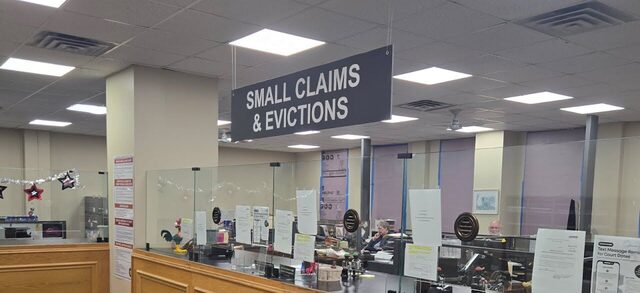
Filing at the clerk's office
A small claims case starts with the sworn affidavit described in our filing guide. Two practical Tulsa County points:
- File in person or by mail. Oklahoma's e-filing system does not accept new small claims cases — the OSCN e-filing guide says so expressly. Plan on the counter in Room 200 or the mailbox. (We file for our clients, so this stops being your problem.)
- The clerk will help — up to a line. The Act requires the clerk to help prepare the affidavit on request (12 O.S. §1754), and the staff are genuinely helpful. But they cannot tell you whom to sue, what to claim, or how to prove it. Those are the decisions that decide the case.
When the affidavit is accepted, the clerk issues the Order to Appear with a hearing date 10 to 60 days out (12 O.S. §1756), and service starts — by clerk's certified mail or licensed private process server (the service guide compares them).
How the docket runs
Small claims hearing days are volume days. Dozens of cases share a setting; the judge calls the list, and each case resolves in one of a few ways:
- Default judgment. The defendant was properly served and didn't come. The plaintiff who can prove service and the amount walks out with a judgment.
- Agreed resolution. Many cases settle in the hallway or through the court's mediation program — often for payment terms entered as a judgment the court can enforce.
- Trial. Contested cases are heard informally — testimony, documents, the judge's questions. No jury unless a party with a claim over $1,500 demanded one in advance (12 O.S. §1761). Most hearings take minutes, not hours.
The pace rewards preparation ruthlessly. The judge has a stack of files and no patience for a plaintiff sorting loose receipts at the podium. Our cases go up with a tabbed exhibit set and a two-minute theory of exactly what's owed and why.
Free mediation — the Early Settlement Center
Tulsa County operates a court-connected mediation program, the Early Settlement Center (2315 Charles Page Blvd., 918-596-7786), which handles small claims disputes among many other case types. Mediation is voluntary, confidential, and free or low-cost — and for a creditor it can produce something valuable: a written payment agreement backed by the court, without burning a hearing setting. We'll tell you when mediation is the fast path to money and when it's a stall tactic.
Planning your courthouse visit
- Security. Courthouse entrances screen everyone — budget a few extra minutes at peak morning hours, and leave pocket knives in the car.
- Parking. Commercial lots and garages sit within a couple of blocks (typically $5–$8 for the visit), including the Civic Center garage at 520 W. 3rd St.; limited metered street parking runs on coins. Downtown mornings are busy — arrive early.
- What to bring. Every document that touches the debt — contract, invoices, statements, the note or check, texts and emails, photos — plus your witnesses. Small claims has no discovery (12 O.S. §1760): what you bring is your case.
Why local practice knowledge matters
Nothing about the Small Claims Procedure Act is unique to Tulsa — but the courthouse is. Knowing how the civil desk processes affidavits, how service through the clerk actually moves, how the special judges run their lists, and when the Early Settlement Center is worth a detour: that's the difference between a case that glides and a case that eats three settings. This docket is the whole practice here — that's by design.